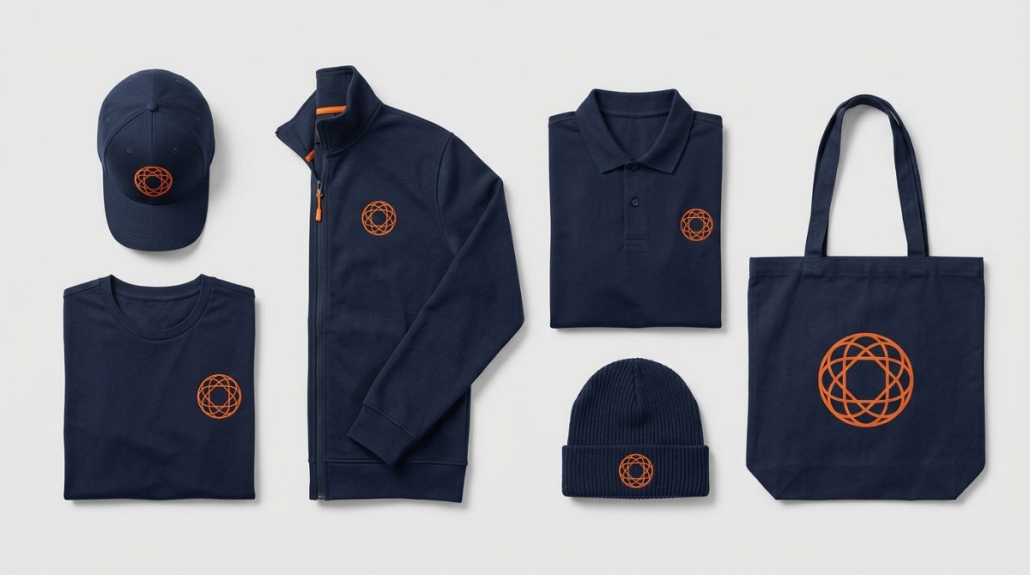
Custom Company Apparel: How to Choose Shirts, Uniforms, and Branding That Last
Walk through any job site, trade show, or busy front desk and you will spot it: a team wearing branded apparel that either looks sharp and intentional, or faded and forgotten in a drawer. That difference is not luck. Choosing the right custom company apparel is a real decision with real payoff, because a well-made branded shirt is one of the hardest working promotional products you own. It gets worn again and again, putting your name in front of people long after a paid ad has disappeared.
The data backs this up. Apparel earns the highest brand recall of any promotional category: 85 percent of people remember the brand on a shirt or jacket they received, and nearly 9 in 10 still recall it up to two years later. A single branded t-shirt generates more than 5,000 impressions over its lifetime, and outerwear pushes past 7,800. Roughly 87 percent of recipients keep a promotional item for more than a year, and 4 in 10 hold onto apparel for a decade or more. Few marketing dollars work that long.
Start with the job your custom company apparel must do
Before you pick a color or a decoration method, get clear on the role your custom company apparel is playing. The right choice looks very different depending on the goal.
- Daily uniforms: durability and comfort matter most, because staff wear these every shift and customers see them constantly.
- Trade show and event gear: visibility wins, so lean on bold logos and colors that read across a crowded room.
- Premium gifts and leadership pieces: here the fabric and finish signal quality, so a heavier polo or a clean embroidered jacket does more than a basic tee.
- Retail or fan merch: people have to actually want to wear it, which means the design should feel like clothing first and advertising second.
Naming the job first keeps you from overspending on a giveaway tee or underspending on a uniform your team will wear 200 days a year.
Screen printing, embroidery, or DTG: choosing the right method
Most decoration questions come down to three methods, and each has a clear sweet spot.
Screen printing is the workhorse for bold designs and larger runs. It produces vibrant, eye-catching graphics at a low per-unit cost once quantities climb, which makes it the go-to for event t-shirts, team apparel, and any order where you need a lot of the same thing. The tradeoff is setup cost per color, so it is less efficient for small batches or highly detailed art.
Embroidery is the premium, professional look. Because the design is stitched directly into the fabric, it resists wear far better than print and holds up wash after wash. It shines on polos, hats, jackets, and corporate uniforms where a small, clean logo signals credibility. Per-piece cost runs higher than screen printing, so reserve it for the pieces that need to look sharp for years.
Direct-to-garment (DTG) handles complex, multi-color, or photographic designs with almost no setup cost, which makes it ideal for small batches, samples, and limited runs. The ink bonds into the fibers for a soft finish that resists cracking. It does not offer the bulk savings of screen printing, so it fits low quantities and detailed art rather than big uniform orders.
A practical rule of thumb: screen print your high-volume shirts, embroider your uniforms and outerwear, and use DTG for detailed or short-run pieces.
Quality is what people actually keep
The impression numbers only pay off if the garment survives. A cheap shirt that pills after three washes gets thrown out, and every impression you paid for goes with it. Spending a little more on a comfortable, well-fitting blank is what turns a one-time handout into years of walking advertising. When people like how a piece feels, they reach for it on their own, and branded apparel stops being a cost and becomes a channel.
A company store makes it repeatable
For growing teams, the hardest part is not the first order, it is the tenth. New hires need gear, sizes run out, and franchise or multi-location brands drift out of sync when everyone orders on their own. A branded company store solves this by putting approved, on-brand apparel in one online storefront where anyone can order the right item in the right size, on demand.
This is exactly what we built for Plumline Nursery. Rather than juggling one-off apparel requests, their team got a branded company store and a coordinated apparel program, so staff gear stays consistent and reordering is simple. The result is a workforce that looks unified and a brand that shows up the same way every day, without the internal scramble.
Getting it right the first time
Great custom company apparel is not about picking the cheapest shirt or the flashiest logo. It is about matching the garment, the decoration method, and the ordering process to the job you need it to do. Do that, and your team turns into thousands of brand impressions that people are happy to carry for years.
Apparel is only one piece of the picture. To see the full lineup of branded gear, from drinkware to bags to tech accessories, explore everything we offer at Wenning Promotional. When you are ready to build an apparel program that represents your brand, from the first shirt to a full company store, get in touch with the Wenning Branding team.